Sun Project
Classroom Work Dates:
o December 3rd - Sun Project Gallery Walk
o December 6th - Planetary Project Review
o December 12th - Individual Work Day (Sun Project)
o December 13th - Individual Work Day (Planetary Project)
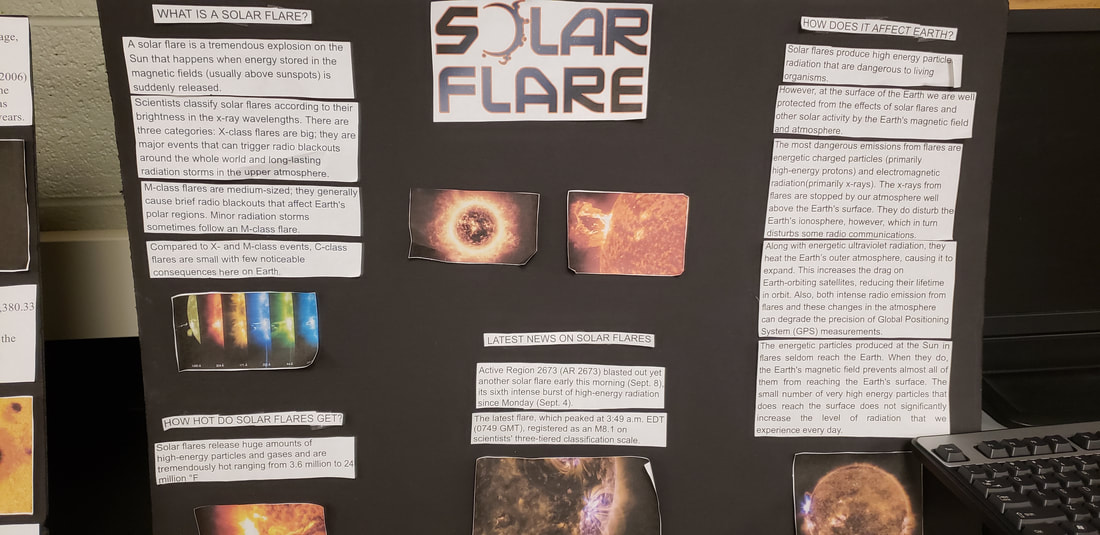
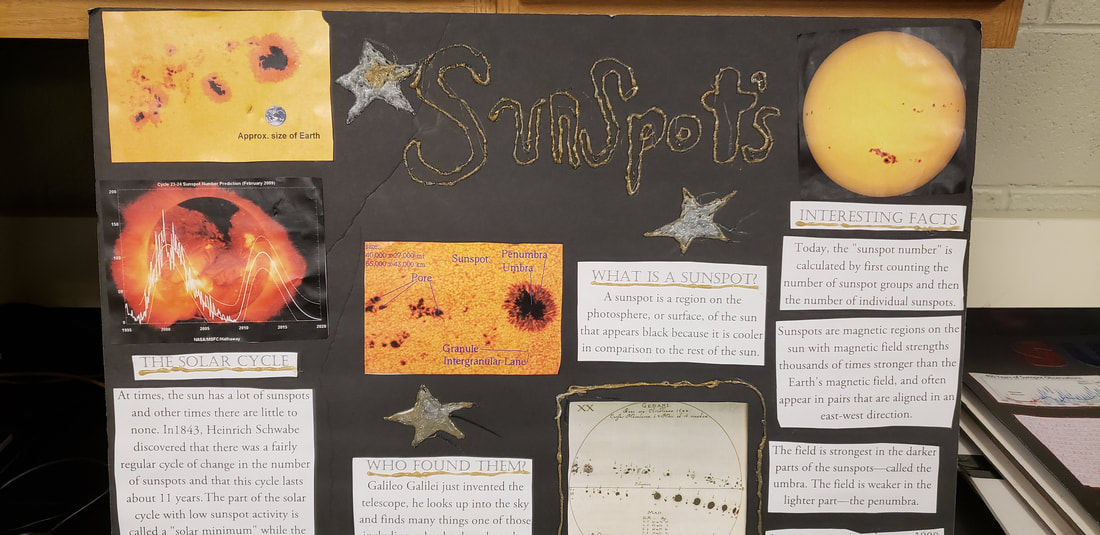
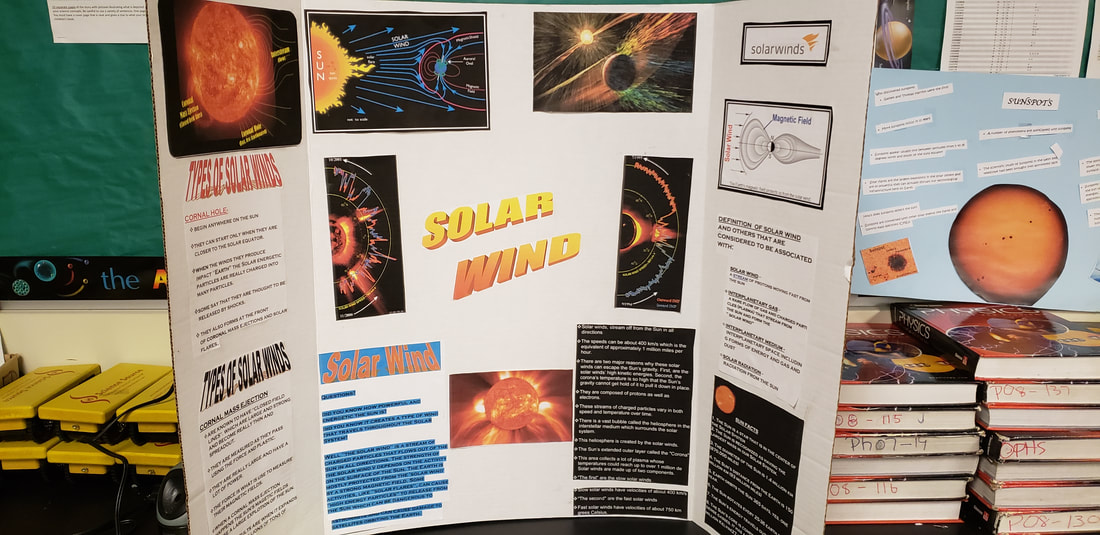
Each student must complete research on one of the Sun's major features (Solar Flare, Solar Wind, Prominence, Sunspots, Solar Structure (or you may pick a topic related to the Sun that you find interesting - I must approve these topics).
o Investigate these topics on the internet sites: NASA, ESA, SOHO, etc.
o Complete a bibliography recording which websites you take information from.
o Construct an information guide to the topic that you chose.
- You must include pictures (or graphs), data and information.
- The Sun Project can be drawn/constructed on anything
you like (bigger than 8.5 x 14).
- Be Creative (it's worth more).
DUE Friday : December 21, 2018
200 points (PROJECT GRADE)
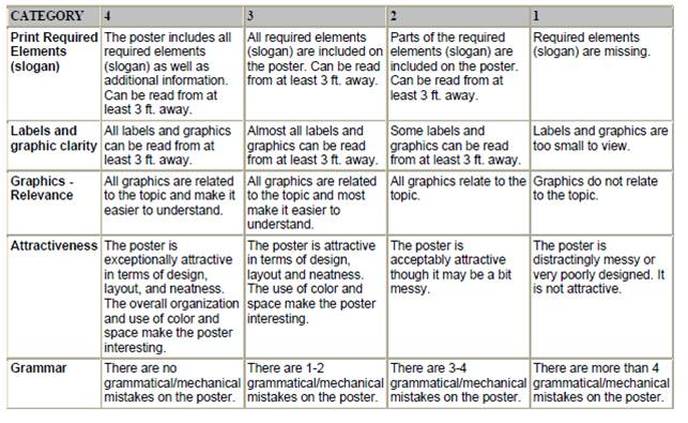
Below is a rubric which shows how your Sun Project will be graded:

Sun Notes
Sun Unit Notes
A very common star: a glowing ball of gas held together by its own gravity and powered by nuclear fusion at its center.
Convection takes over when the gas is too opaque for radiative energy transport.
Pressure (from heat caused by nuclear reactions) balances the gravitational pull toward the Sun’s center. Called “Hydrostatic Equilibrium.
Luminosity is the total light energy emitted per second.
Please complete the following notes in you journal:
How do we know the interior structure of the Sun?
The Solar Interior “Helioseismology”
In the 1960s, it was discovered that the surface of the Sun vibrates like a bell
Internal pressure waves reflect off the photosphere
Analysis of the surface patterns of these waves tell us about the inside of the Sun
Hot coronal gas escapes the Sun as the Solar wind.
Coronal gas has enough heat (kinetic) energy to escape the Sun’s gravity.
The Sun is evaporating via this “wind”. Solar wind travels at ~500 km/s, reaching Earth in ~3 days.
Dark, cool areas called sunspots appear on the photosphere. Energy is carried to the surface of the Sun through a process called convection.
In its interior, the Sun can hold over 1.3 million Earths.
The Sun composes over 99% of the solar system’s mass.
Arches of gas from the chromosphere that rise and orient themselves along magnetic lines are called prominences.
The solar atmosphere is so hot that the gas is primarily in a plasma state.
Abrupt violent explosions from the Sun are called solar flares.
Granulation is the bubbling effect seen on the surface of the Sun.
The Sun’s atmosphere is ‘composed’ of three main parts the photosphere, chromosphere and corona.
A very common star: a glowing ball of gas held together by its own gravity and powered by nuclear fusion at its center.
Convection takes over when the gas is too opaque for radiative energy transport.
Pressure (from heat caused by nuclear reactions) balances the gravitational pull toward the Sun’s center. Called “Hydrostatic Equilibrium.
Luminosity is the total light energy emitted per second.
Please complete the following notes in you journal:
How do we know the interior structure of the Sun?
The Solar Interior “Helioseismology”
In the 1960s, it was discovered that the surface of the Sun vibrates like a bell
Internal pressure waves reflect off the photosphere
Analysis of the surface patterns of these waves tell us about the inside of the Sun
- Our sole source of light and heat in the solar system
- Hot gas is less dense and rises (or “floats,” like a hot air balloon or a beach ball in a pool).
- Cool gas is more dense and sinks
Hot coronal gas escapes the Sun as the Solar wind.
Coronal gas has enough heat (kinetic) energy to escape the Sun’s gravity.
The Sun is evaporating via this “wind”. Solar wind travels at ~500 km/s, reaching Earth in ~3 days.
Dark, cool areas called sunspots appear on the photosphere. Energy is carried to the surface of the Sun through a process called convection.
In its interior, the Sun can hold over 1.3 million Earths.
The Sun composes over 99% of the solar system’s mass.
Arches of gas from the chromosphere that rise and orient themselves along magnetic lines are called prominences.
The solar atmosphere is so hot that the gas is primarily in a plasma state.
Abrupt violent explosions from the Sun are called solar flares.
Granulation is the bubbling effect seen on the surface of the Sun.
The Sun’s atmosphere is ‘composed’ of three main parts the photosphere, chromosphere and corona.
Electromagnetic Waves Virtual Laboratory
Using the link below, complete the attached laboratory:
Electromagnetic Spectrum Virtual Lab
When electrically charged particles move, electromagnetic waves are produced. These waves travel outward, or radiate, from the charged particles. Visible light is an electromagnetic wave, as are radio waves, microwaves, infrared waves, ultraviolet waves, and X rays. All the different types of electromagnetic waves form the electromagnetic spectrum.
Objectives:
- Match visual representations of waves to their written descriptions.
- Identify and describe the parts of the electromagnetic spectrum.
- Compare and order different types of electromagnetic waves by frequency, wavelength, and energy.
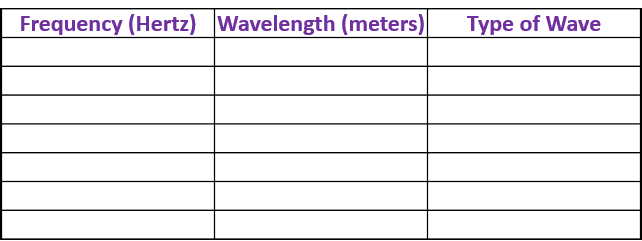
Using the chart below, (draw in journal) complete the assigned virtual laboratory:
Sun Unit Re-Test Review
These are the top 10 most challenging questions on the test (according to the initial student test scores)
These are the top 10 most challenging questions on the test (according to the initial student test scores)
- Charged particles captured by Earth’s magnetic field are pushed away from the Sun by the __________.
- What is the magnetosphere?
- The Sun, through the process of fusion converts 2 helium atoms into a hydrogen atom. (True or False)
- Energy is carried to the surface of the Sun through a process called _______.
- The Sun's outer visible layer is called the _______.
- The ___ is the outermost layer of the Sun, which is usually only seen during eclipses.
- The Earth orbits, on average, ____ miles from the Sun.
- Sketch an example of Hydrostatic Equilibrium.
- From the "Sun Video", what was the first significant solar observatory in space?
- When a solar prominence eventually forms loops and becomes tangled the ____________ _______________ of the Sun are responsible.
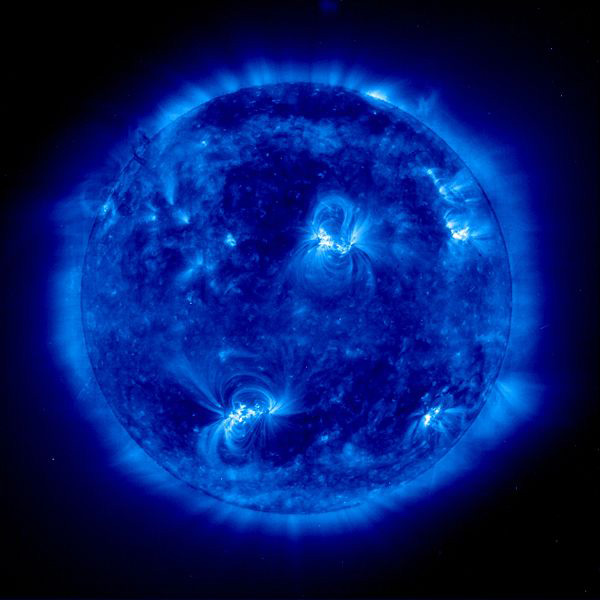
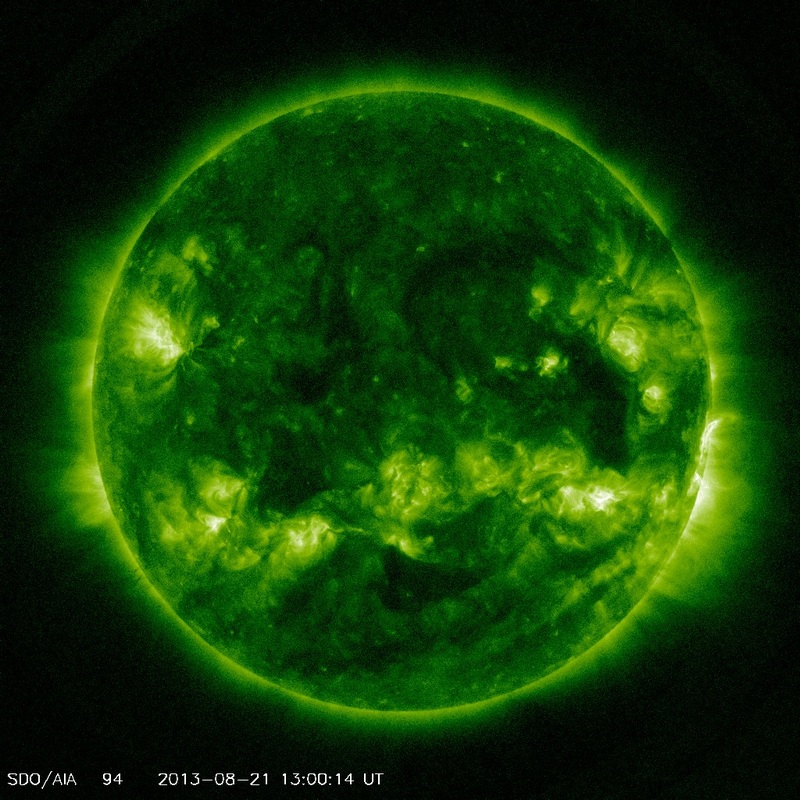
See Some Examples
|
|
|