Oak Park High School, Oak Park, Michigan
Mercerology
  • OPHS Mission and Syllabi
  • The Sun
Galaxy Quiz

1st Hour

2nd Hour

5th Hour 


Picture

What is a “star cluster”?

  • stars formed together at same time
  • stars may be gravitationally bound together
  • two types:  open (galactic) and globular

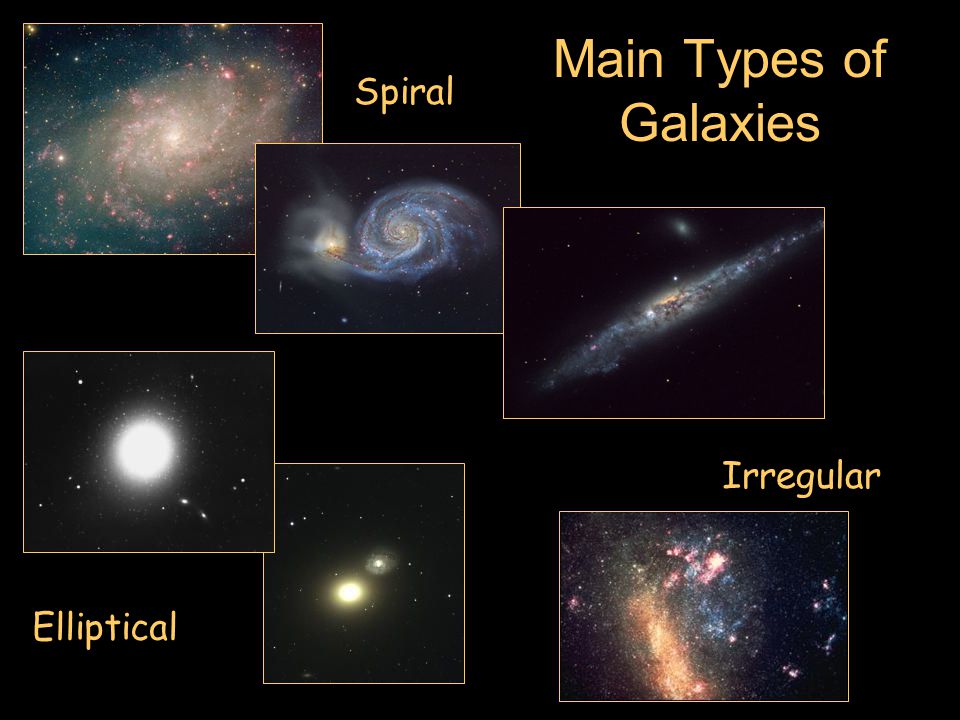
What is a “galaxy”?

​
A large group of stars outside of our own Milky Way (Vastly different sizes and luminosities)
  • Made of billions to trillions of stars
  • Also may have gas and dust

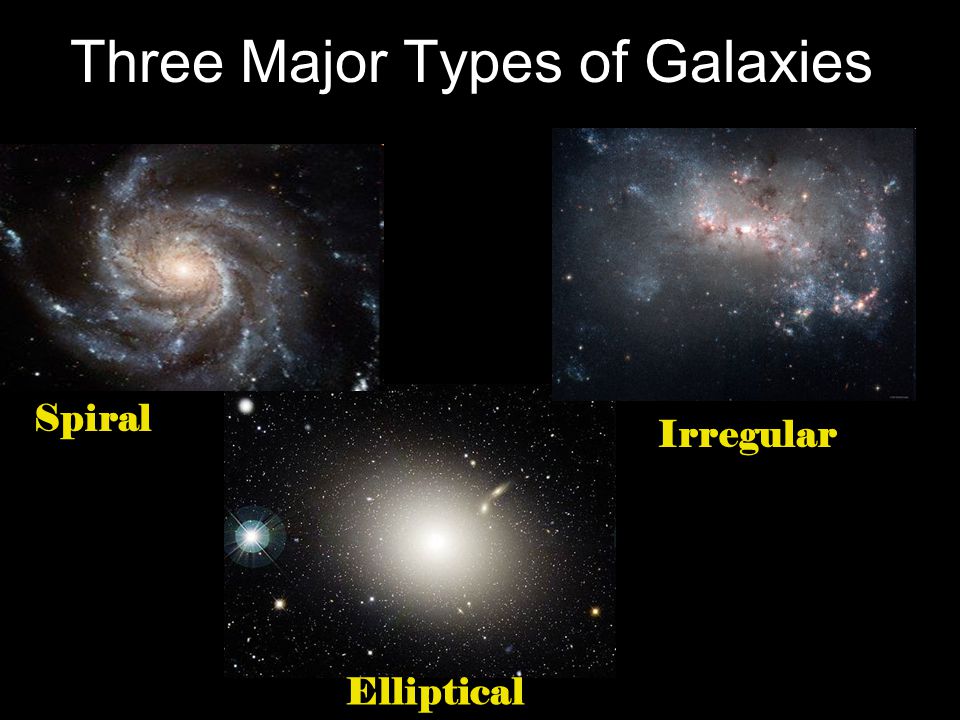
TYPES:

  • ​Spiral - rich in gas and dust
  • Elliptical - lack large amounts of gas and dust
  • Irregular - result from galaxy collisions/mergers; very active star formation 

What is a Light Year?
  • A light year is the distance light travels in a year.
  • Light moves at a velocity of about 300,000 kilometers (km) each second; how far would it move in a year? About 10 trillion km (or about 6 trillion miles).

It would take 11,780 Earths lined up side to side to bridge the 1 AU between Earth and Sun.

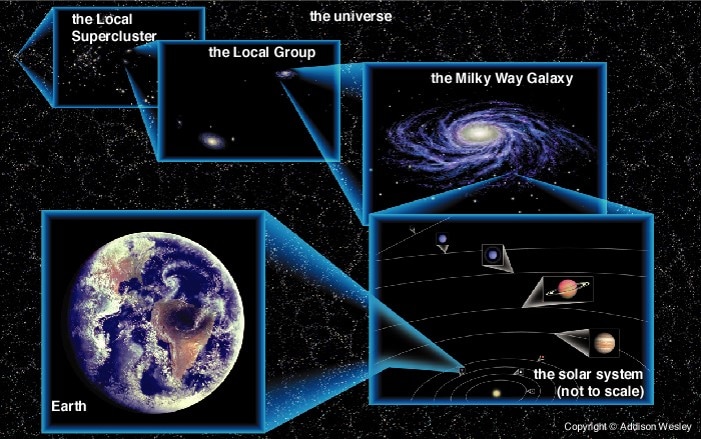
The Local Group

Composed of three (3) Galaxies:
  • Milky Way Galaxy
  1. The Milky Way Galaxy is a giant disk of stars 100,000 light-years across and 1,000 light-years thick.
  2. It takes 200 Million years for the Sun to complete one orbit.
  3. There are over 100 Billion stars in the Milky Way
  • Andromeda Galaxy
  • Triangulum Galaxy
Plus a few dozen dwarf galaxies with elliptical or irregular shapes.
Gravitationally bound together—orbiting about a common center of mass
The region of the Galaxy within about 32.6 light-years of the Sun (65 light-years diameter) is considered its neighborhood. 


The Local Supercluster
  • A cluster of many groups and clusters of galaxies
  • Largest cluster is the Virgo cluster containing over a thousand galaxies.

The Universe

The observable Universe is 27 Billion light-years in diameter.
Probably 100 Billion galaxies in the Universe
Step 1 - Learn about our Universe   

Complete the following questions/worksheet using the "Scale of the Universe" diagram.

Scale of the Universe

Activity 1:  Describe what objects/creatures/items you will see at:
1 x 10 -1.8                     1 x 10 -19.5                         1 x 10 2.8 1 x 10 -4.6                     1 x 10 -21.8                         1 x 10 12.5 1 x 10 -10.0                   1 x 10 -24.0                         1 x 10 14.8 1 x 10 -14.0                   1 x 10 4.4                           1 x 10 18

Activity 2:  Provide the names of the following numbers: 1 x 10 -6                   1 x 10 -24                        1 x 10 21
1 x 10 -12                 1 x 10 -21                        1 x 10 15
1 x 10 -9                   1 x 10 6                           1 x 10 12


Step 2 - Review the Scale of the Universe  

Please write the questions and answers using the Scale of the Universe virtual lab and a little research on the internet.

3. What are the three smallest hypothetical objects in the universe?
4. What is the distance from the Earth to the Sun?
5. What is the Voyager I? Where is it right now?
6. How large is a parsec?
7. Calculate the distance that light travels in one year; show your work.
8. How long does it takes light to arrive here from the Sun?
9. Provide a brief description of the Great Attractor.

10. What is the estimated size of the universe?
11. What is Red Shift?

Powered by Create your own unique website with customizable templates.